
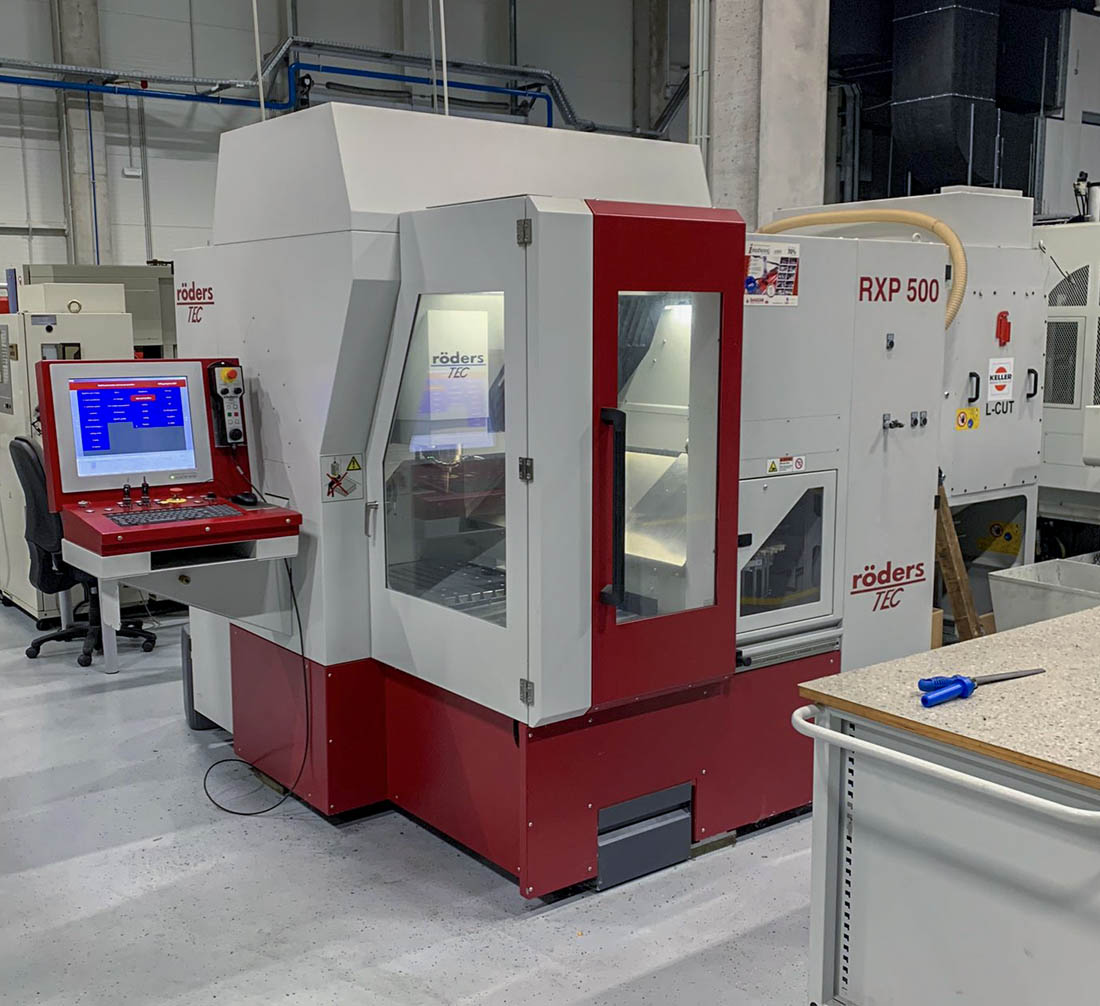
Tool and mold making is the industry with the densest concentration of high-value CNC machines in Germany — and, at the same time, the industry under the greatest pressure to renew its equipment. We’ve been buying machines from this segment across Germany for years, with a particular focus on the Bergisches Land, the Sauerland, East Westphalia-Lippe, the Black Forest, and Tuttlingen. Initial assessment, payment before pickup, and a level of discretion suited to sensitive phases such as generational transitions or consolidations.
German tool and mold making in numbers
Germany is by far the largest tool- and mold-making hub in Europe. The Verband Deutscher Werkzeug- und Formenbauer e.V. (VDWF), the German association of tool and mold makers, represents the industry nationwide; the business landscape ranges from small workshops to larger core operations. Production is spread across four main clusters:
- Bergisches Land (Solingen, Remscheid, Wuppertal, Velbert): the classic cluster for stamping and cutting tools, cutlery, and fittings. It has the highest density of profile and surface grinding machines, plus EDM equipment.
- Sauerland (Lüdenscheid, Iserlohn, Olpe, Meschede, Arnsberg): focused on stamping and deep-draw tools, fitting manufacturing, and injection-molded plastic tooling.
- Black Forest and Tuttlingen (Furtwangen, Schramberg, St. Georgen, Tuttlingen): micro mold making and surgical instruments — the finest precision in German tool-making.
- East Westphalia-Lippe (Lemgo, Bielefeld, Detmold, Lippstadt): tool making for household appliances and electrical engineering, often connected to OEM clusters (Beckhoff, Phoenix Contact, Miele, Hettich).
Important secondary clusters exist in the Allgäu, Middle Franconia, and the greater Stuttgart area. In total, this industry holds a large number of high-value CNC machine tools — from micro milling machines for watch-stamping dies to large 5-axis machining centers for automotive deep-draw tools.
Structural change is freeing up machines
Three developments are currently driving the largest machine secondary market coming out of tool and mold making:
Generational transitions without a successor. The typical German tool- and mold-making business is small to mid-sized and often family-owned for several generations. A notable share of owners have no in-family successor and no active sales process underway for the company. One workable path: liquidate the machine fleet separately, sell the building, and wind down the business in an orderly way. We see this pattern most often in the Bergisches Land and the Sauerland.
Consolidation in the Mittelstand. Larger mold-making groups buy smaller competitors and consolidate sites. Acquired machines are partly retained and partly replaced with newer ones — the rest goes to the secondary market. This pattern often comes with tight timeframes (three to six months), because leases or property sales are tied to fixed dates.
Modernization toward complete 5-axis machining. Especially in Tuttlingen and the Black Forest, there’s a visible trend away from classic 3-axis milling followed by EDM, toward complete 5-axis machining with micro milling. The old 3-axis machines aren’t broken — they simply no longer fit the new process design. For buyers in Eastern European mold making who haven’t yet switched to complete 5-axis machining, these machines are an attractive offer.
Typical machine classes from tool and mold making
| Machine class | Typical models | Main application in the industry |
|---|---|---|
| HSC machining centers | Röders RXP, Mikron HSM, Fehlmann Picomax, OPS Ingersoll Eagle | Hard milling of hardened tool steels 1.2343, 1.2767, 1.2738 |
| Premium 5-axis milling machines | Hermle C-series, DMG MORI DMU 50/75/85 monoBLOCK, Mikron 5AX | Complex mold geometry without repositioning |
| Sinker EDM machines | Charmilles Roboform 350/550, ONA QX series, Sodick AG series | Deep cavities, sharp internal edges |
| Wire EDM machines | AGIE Charmilles CUT 200/300, Sodick AQ, Mitsubishi MV | Contour cuts in hardened steels, insert parts |
| High-precision grinding machines | Studer S31/S33/S41, Jung J630, Wanderer, Voumard | Internal and external round high-precision work on tooling punches |
| Surface grinding machines | Mägerle MFP, Jung 630/1200, Okamoto, Chevalier | Plate grinding, chuck refurbishment |
| Tool grinding machines | Walter Helitronic, ANCA TX, Reinecker, Saacke | Regrinding of end mills, drills, special tools |
| Measurement and presetting equipment | Zoller Smile/Genius, Haimer UNO, Zeiss Contura, DEA Global | Tool presetting, CMM, form and position measurement |
This table isn’t exhaustive; it shows what we most often buy from tool- and mold-making fleets.
Trial-run machines are included. Many mold makers for injection molds run their own injection molding machines to sample new tools. We buy these machines as well. They are valued not by spindle hours but by clamping force, shot count, and control — see selling an injection molding machine.
What makes this industry different when it comes to selling
Discretion during sensitive phases. In tool and mold making, almost every sales inquiry starts out non-public. Competitors, customers, and suppliers shouldn’t learn that a site is being cleared unless the owner actively communicates it. We arrive without company vehicles and under a confidentiality agreement whenever requested.
Tooling residual value as a separate line item. Unlike in many other industries, the tooling (injection molds, stamping dies, die-casting tools) is often worth nearly as much as the machines that made it. Premium tool steels such as 1.2738, 1.2767, 1.2343, 1.2379, and 1.3343 in well-preserved tools have their own resale market — both as raw stock for reworking and as tooling for other applications. We value both separately and list them apart in the offer.
Fast handling for line shutdowns. Consolidations often create tight windows — a lease expiring, a property buyer taking over on a fixed date, a new site needing the space. We deliver initial assessments and can usually pick up within 7 to 15 working days of first contact, even for complete facility contents — see factory clearance.
CAD data and post-processor programs stay with you. In tool and mold making, CNC controls often hold customer-confidential machining programs. We clear the control’s memory together with you before pickup and document it in writing.
Direct purchase during modernization. If you’re moving to a new machine generation — say, from a Mikron HSM to a Röders RXP, or from a Hermle C 42 U to a Hermle C 42 U Dynamics — we buy the old machine at full market value through a direct sale, even across manufacturer changes. You free up the proceeds for your new purchase; we’re buyers, not a new-machine supplier. Described in detail on our workshop modernization page.
What we especially like to buy from tool and mold making
HSC machining centers. Röders RXP 500 DSC with Röders RMS6 control. Mikron HSM 400U, HSM 600U, HSM 800 LP with GE Fanuc or Heidenhain. Fehlmann Picomax 90 and 95. OPS Ingersoll Eagle V9 with an extended tool magazine. These machines find immediate buyers in every industrial region.
Hermle C-series for mold making. Hermle C 22 (micro range), C 32 U and C 42 U (standard for mid-sized molds), C 52 U (large molds). With Heidenhain iTNC 530 or TNC 640. Hermle is the brand with the highest resale value in the premium 5-axis segment — see Hermle buying.
DMG MORI duoBLOCK for large molds. DMU 125 P duoBLOCK, DMU 160 P duoBLOCK, DMC 160 U duoBLOCK. For deep-draw tools and large injection molds in automotive applications. Very much in demand in the large-mold market.
Premium EDM machines. Charmilles Roboform 350/550, ONA QX 600/800/1200 sinker EDM machines. AGIE Charmilles CUT 200/300/2000 OilTech and Sodick’s AQ series for wire EDM. These machines have an active market not only in Germany but also in Italy, Spain, Poland, Turkey, and Mexico.
Profile and cylindrical grinding machines. Studer S31, S33, S41 universal cylindrical grinders — the brand with the highest residual value in the cylindrical grinding segment, see Studer buying. Jung J630/1200 surface grinders. Mägerle MFP. Wanderer for profile grinding.
Tool grinding machines. Walter Helitronic series (HMC 400, HMC 800, Helitronic Power), ANCA TX series, Reinecker WZS 60, Saacke UWIB 6 — all with active demand in Eastern European tool grinding shops and Indian tool manufacturing.
High-precision measuring machines. Zeiss Contura, Zeiss Prismo, DEA Global Performance, Mitutoyo Crysta-Apex. Sold together when a tool-making site is fully wound down, and with their own secondary market.
Process for a tool- and mold-making purchase
- Initial inquiry with a confidentiality agreement. You contact us by email or phone. We sign a standardized confidentiality agreement (an NDA under German law) before any data is shared, if you want one.
- Machine data + photos. Brand, model, year, spindle hours, control system, a photo of the nameplate and the control. For multi-machine inquiries, a list is sufficient.
- Non-binding valuation. Standard mold-making machines are valued from concrete market data, since we assess these models continuously.
- On-site visit (confidential). For machine values above €60,000 on a case-by-case basis, always for full facility clearances. We arrive outside core working hours if requested, in unmarked vehicles.
- Offer. With separately listed line items for machines, tooling, and measurement and fixture equipment.
- Contract, payment, pickup. Payment by bank transfer, confirmed in writing in your account before disassembly begins. From first contact to pickup usually takes 7–15 working days.
Request a free valuation of your tool- and mold-making machines. Initial assessment — discreet, in writing, with no obligation.