
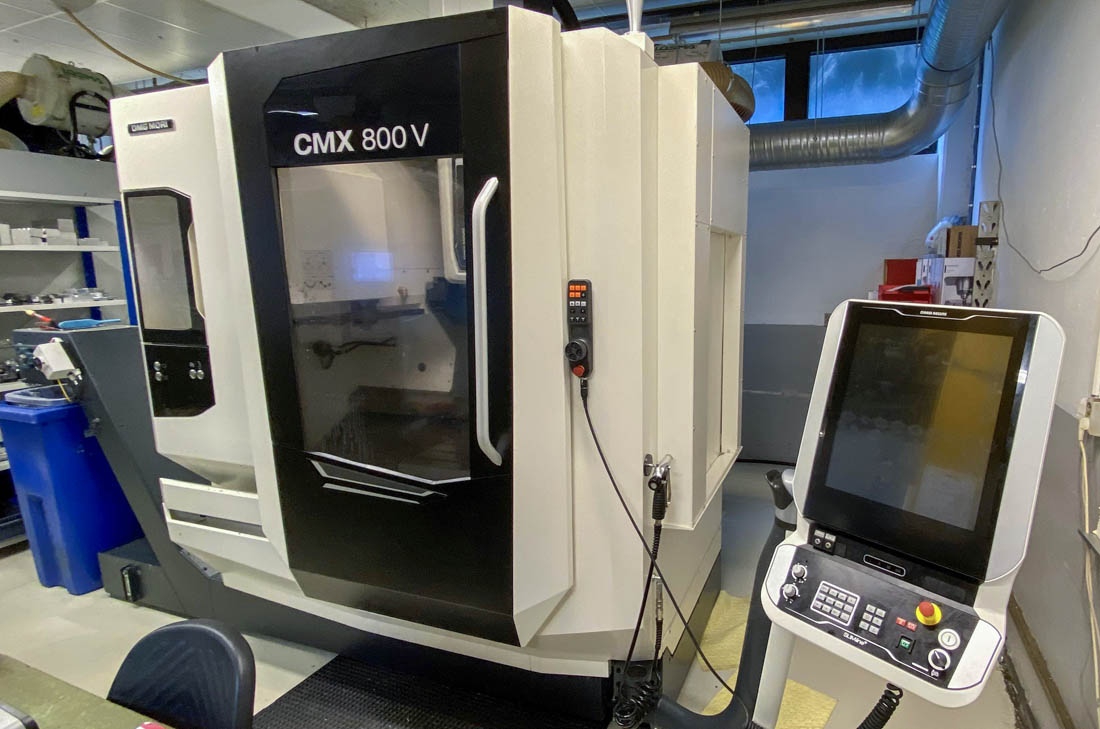
If you have a CNC milling machine and want to sell it, we’ll give you a no-obligation valuation for brands and configurations with genuine secondary-market demand. We prioritize well-maintained machines with commercial potential; we assess the rest just as honestly. No unnecessary site visits up front, a concrete offer, and no commission when we buy directly.
Bed-type milling machines
The most common category in industrial machining. The fixed bed provides maximum rigidity and geometric accuracy. In the classic design the table travels in the X-axis; travel varies markedly by series.
Leading brands in highest demand: Heller (MC, MCi series), Chiron (FZ, DZ series), Burkhardt+Weber (MCX, FMX series), Hermle (C series).
“The German bed-type mill — Heller, Chiron, Burkhardt+Weber — remains the most sought-after machine in the secondary market. Its mechanical robustness often allows for a significantly extended second service life with a suitable control retrofit,” explains Marcel Brockmann, CEO and co-founder of webuyyourmachinetools.com.
Moving-column milling machines
Designed for large, heavy workpieces that can’t travel on a table. The column moves longitudinally while the workpiece stays static. X-axis travel from 3,000 mm, for example in machine building, steel construction, and power-plant construction.
Key brands: Waldrich Coburg (BFT, BF series), Union Chemnitz (PC series), Scharmann (Ecoforce), Heckert (CWK series).
Universal milling machines
Combine vertical and horizontal milling operations via a swiveling head. Highly valued in toolmaking and mold-making shops for their operational flexibility.
Common brands: Deckel (FP series), Maho (MH series), Huron (KX, MU series), Kondia (FV).
Gantry and bridge-type milling machines (large-format)
The large-format segment: machines from 10 to 300 tonnes, with travel that can exceed 10 meters on the X-axis. Main industries: aerospace, shipbuilding, wind energy, large-format mold making. These machines require specialized resources for disassembly and transport.
Brands: Waldrich Coburg (gantry machining centers), Heckert (gantry machining centers), Union Chemnitz (gantry mills), Dörries Scharmann (Ecoforce gantry).
For this segment, see our dedicated page on gantry and large-format milling machines.
5-axis milling machines
High-end 5-axis centers come in two main configurations: swivel/rotary table (trunnion) and swivel head with rotary table. Maximum value retention on the secondary market. Sustained demand in European and North American export markets.
Premium brands: Hermle (C series: C22, C32, C42, C52, C62), DMG MORI (DMU 50, DMU 70, DMU 85, DMC 85 FD), Mazak (Variaxis i-500, i-700, i-800), Okuma (MU-400V, MU-500V), Heller (HF 3000, HF 5000).
“A 2015 Hermle C42 with fewer than 8,000 spindle hours is one of the most value-stable machines of its class in the current secondary market. That value retention is exceptional compared to any other machine tool category,” Brockmann emphasizes.
What the professional buyer evaluates: the five real price factors
Not all CNC milling machines are worth the same, even with identical travel. Five factors determine the real market price:
| Factor | Price impact | Practical example |
|---|---|---|
| Brand and series | High (±30%) | A Hermle C42 typically commands a 25–35% higher price than a comparable mid-range machine with the same travel |
| CNC control and generation | High (±25%) | Heidenhain TNC 640 or Fanuc 31i typically retain more value than a TNC 426 or Fanuc 0i |
| Spindle hours | Medium-high (±20%) | Under 12,000 hrs: base price. Over 25,000 hrs: typically a 15–30% discount |
| Geometric condition | Medium (±15%) | Machines with a current geometry report (Renishaw ballbar) build more buyer confidence and typically achieve a higher sale price |
| Integrated accessories | Medium (±10–15%) | 4th axis, Renishaw workpiece probe, through-spindle coolant: typically raise the value |
“The most common mistake in valuing a used milling machine is focusing only on the year built. An older Hermle with 7,000 spindle hours and a Heidenhain TNC 640 installed is worth more than an Asian machine from 2018 with 22,000 hours and a proprietary base control,” Brockmann explains.
Value retention by brand: a current comparison
Manufacturers with a consolidated service network, guaranteed spare parts, and a reputation for reliability retain significantly more value on the secondary market. Premium brands like Hermle and DMG MORI hold their value noticeably better over ten years than mid-range brands like Haas or Doosan/DN Solutions — whose target markets tend to be more price-sensitive regions such as Turkey or Poland. Heller, Mazak, and Chiron sit in between with solid but somewhat lower value retention, and remain in strong demand for European automotive and high-speed milling production.
Milling machines without documentation, older units, or units with defects: case-by-case valuation
“On a 5-axis milling machine, swivel-head geometry and spindle condition are the two factors that most strongly determine the price. We measure runout error, backlash, and bearing temperature before setting the offer. That lets us pay more than someone buying blind.”
— Lucas Agustí, COO and co-founder of webuyyourmachinetools.com
In many cases, the secondary market still absorbs machines with defects, when the base frame and brand justify it. We assess realistically:
- Without original documentation: Identification via nameplate, serial number, and manufacturer records; can reduce the price.
- Milling machines over 20 years old: Heller, Chiron, and Burkhardt+Weber from the 1990s–2000s can still be of interest with an upgradable control; other configurations may not fit.
- Mechanical or electrical faults: Value depends on repair cost relative to market price; we don’t promise a purchase where there’s no demand.
- Degraded geometry: Only where a buyer still exists at an economically viable price (workshops with lower requirements, training centers, etc.).
Why sell to us instead of the competition
The buyer who pays the real price for a CNC milling machine isn’t always in the local market. Our active access to end buyers across Europe and internationally — without publicly listing the machine — makes the difference between a distress-sale price and the real market price.
Value factors by milling machine type
For these machine types we have no reliable public price range. Every machine is different: we determine the value after assessing your specific unit.
| Milling machine type | What mainly determines the value |
|---|---|
| Large-format moving-column mill (Waldrich, Union Chemnitz) | Travel, table load, control, condition of guideways and drives |
| 5-axis DMG DMU 70 / DMU 85 | Year, control generation, spindle hours, condition of the swivel/rotary table |
| Gantry mill Waldrich / Heckert | Gantry dimensions, milling-head equipment, control, condition |
| Universal mill Deckel / Maho, conventional | Condition of spindle and guideways, accessories such as dividing head and angle head, completeness |
How to sell us your CNC milling machine: three simple steps
No commission to the seller when we buy directly. No unnecessary site visits before the valuation.
- Submit the data: Brand, model, year, CNC control, travel (X, Y, Z), general condition, and photos. Get in touch here.
- Get an initial assessment: no obligation. If we need more information, we’ll request it in the same message.
- Get paid and you’re done: We coordinate disassembly, loading, and transport. Payment is arranged and confirmed before the machine is picked up.
Read the complete step-by-step process or compare the available selling options to make an informed decision.
By machine type: Sell CNC machining centers · Sell gantry and large-format milling machines for large-format equipment. More price information: Price of a used CNC milling machine.