
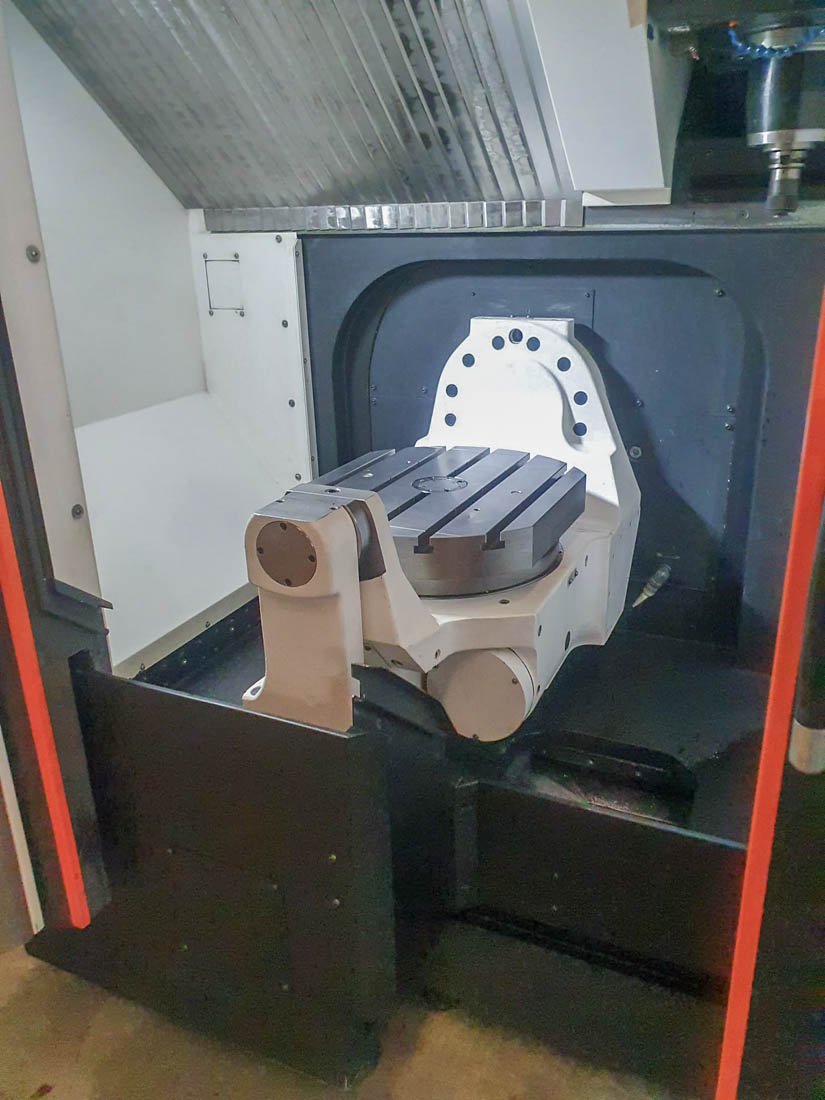
If you have an HMC and want to sell it, we’ll give you a no-obligation initial assessment for brands and configurations (with or without pallets) that have genuine demand. We prioritize units in good commercial condition; we assess the others without promising a purchase where there’s no suitable outlet. An offer tailored to your situation.
For an overview of all designs — vertical, horizontal, and 5-axis — see our page Sell machining centers.
Why the HMC dominates high-performance industrial production
4-sided machining in one pass: The 90° B rotary table (or 360° indexed) allows machining of all four side faces of a cubic workpiece without pallet movement. That eliminates cumulative re-clamping errors and drastically reduces cycle time in complex-part production.
Gravity chip removal: With a horizontally positioned spindle, chips fall freely downward and are cleared by the integrated conveyor. That prevents the critical chip re-accumulation seen on VMCs when high-speed machining aerospace aluminum.
Interchangeable pallet system: While a workpiece is machined on pallet A, the operator loads or unloads pallet B. Load time doesn’t affect the machine’s cycle time: effective availability is correspondingly high in well-configured lines.
Horizontal machining centers make up only a small share of the installed European machine fleet, but they contribute disproportionately to production output per machine-hour. That productivity explains their premium on the secondary market.
Most active HMC brands and models internationally
| Brand | Main models | Technical highlight |
|---|---|---|
| DMG MORI | NHX 4000, NHX 5000, NHX 6300, NH DCG | DCG (Driven at Center of Gravity) = less vibration, higher speed |
| Mazak | HCN-4000, HCN-5000, HCN-6800 | Palletech up to 240 pallets, SmoothG/SmoothX |
| Okuma | MA-400H, MA-550H, MA-600H | OSP-P300 control, high speed, thermal compensation |
| Heller | H 2000, H 4000, H 5000 | Widespread in the German automotive industry and European Tier-1 suppliers |
| Grob | G350, G550, G750 | Integrated simultaneous 5-axis in a horizontal design |
| Makino | a51, a61, a71, a81 | Reference in Japanese automotive and aerospace production |
| Chiron | FZ 16 S five axis, ML series | Extreme speed, compact footprint |
“The Makino a81 is the de facto reference in engine-component production lines. When one appears in good condition on the European secondary market, there are active buyers in Turkey and Mexico before it even reaches a public platform,” explains Marcel Brockmann, CEO and co-founder of webuyyourmachinetools.com.
Buying complete FMS cells: our specialty
FMS cells (Flexible Manufacturing Systems) are the most complex — and also the most valuable — asset on the used industrial machinery market. A typical cell can include:
- 2–8 HMCs from the same family (same pallets, same toolholders, same communication interface)
- Pallet transport system (Fastems, Mazak Palletech, Erowa Robot, Schuler, Stopa)
- MES production management software (priority coordination, pallet status, alarms)
- Centralized tooling system (automatic presetting, tool vending)
- Load/unload robots and centralized chip conveyor
The total value of a well-configured FMS cell is noticeably higher than the sum of the individually sold machines. We buy complete cells with a single negotiation, a single disassembly process, and full management of specialized logistics. For the seller: one price, one point of contact, the facility cleared within the agreed timeframe.
“Disassembling an FMS cell is the most complex logistics project we manage. We have to number every pallet, document the hydraulic and pneumatic connections, and sequence the extraction so as not to damage the transport systems. We do that with plans in hand before we touch a single bolt.”
— Lucas Agustí, COO and co-founder of webuyyourmachinetools.com
Specific HMC valuation factors
Pallet system: the decisive differentiator
Standard dual pallet or multi-pallet system (4, 8, 16+)? Every extra pallet station extends unmanned run time. A well-configured and documented 8-pallet system raises the total installation value; we have no reliable public price range for it. Compatibility of the pallet system with pallet carriers available on the market (400×400, 500×500, 630×630, 800×800 mm sizes) directly affects the asset’s liquidity.
Spindle: speed and condition
HMCs have two industry-differentiated spindle profiles:
- 8,000–12,000 rpm: steel and cast-iron profile (automotive, capital goods)
- 15,000–20,000 rpm: aerospace aluminum profile (higher market value, smaller standard buyer pool)
Spindle condition — hours, maintenance history, runout test — is the most decisive price factor. A spindle with fewer than 8,000 hours in a 2010 machine is worth more than one with 20,000 hours in a 2018 machine.
Magazine and toolholders
A 120-tool magazine typically adds 15% to 25% over a 40-position one on the same model. Capto C6 or ISO-50 toolholder systems raise value through compatibility. A magazine with 180+ tools is a high-value differentiator for complex-part production.
CNC control and generation
Controls that add the most value in the current HMC market:
- DMG CELOS with Heidenhain TNC 640: maximum connectivity, high demand in Europe and Asia
- Mazak SmoothG / SmoothX: key for integration with Palletech systems
- Okuma OSP-P300: standard on Japanese automotive lines
- Siemens 840D SL: preferred by German and French Tier-1 suppliers
Older-generation controls — Fanuc 18i, Siemens 810D, Mazatrol 640 — are functional but typically reduce the perceived price by 15–25% compared to versions with a modern control.
Prices on the HMC secondary market
For the DMG NHX 4000 and 5000, Mazak HCN-4000 and HCN-6800, Makino a61 / a81, Grob G550, Heller H 4000, and complete FMS cells we have no reliable public price range; we therefore don’t quote a blanket figure. The value is determined by year, spindle hours, pallet configuration, control, and condition (see above).
Why the HMC buyer isn’t in the local market
A production HMC needs to be integrated into a high-performance production line. The pool of local buyers with this need and budget is small. The buyer who pays the real price is international: expanding automotive plants in Turkey (Bursa, Kocaeli), component manufacturers in Poland (Wrocław, Poznań, Gliwice), aerospace industry in Mexico (Querétaro, Monterrey), or Indian Tier-1 suppliers in Maharashtra and Tamil Nadu.
We maintain active relationships with end buyers in all of these markets. That lets us offer you more than you’d get on the local market.
Request a free valuation of your HMC or FMS cell. We usually respond with a no-obligation initial assessment.