
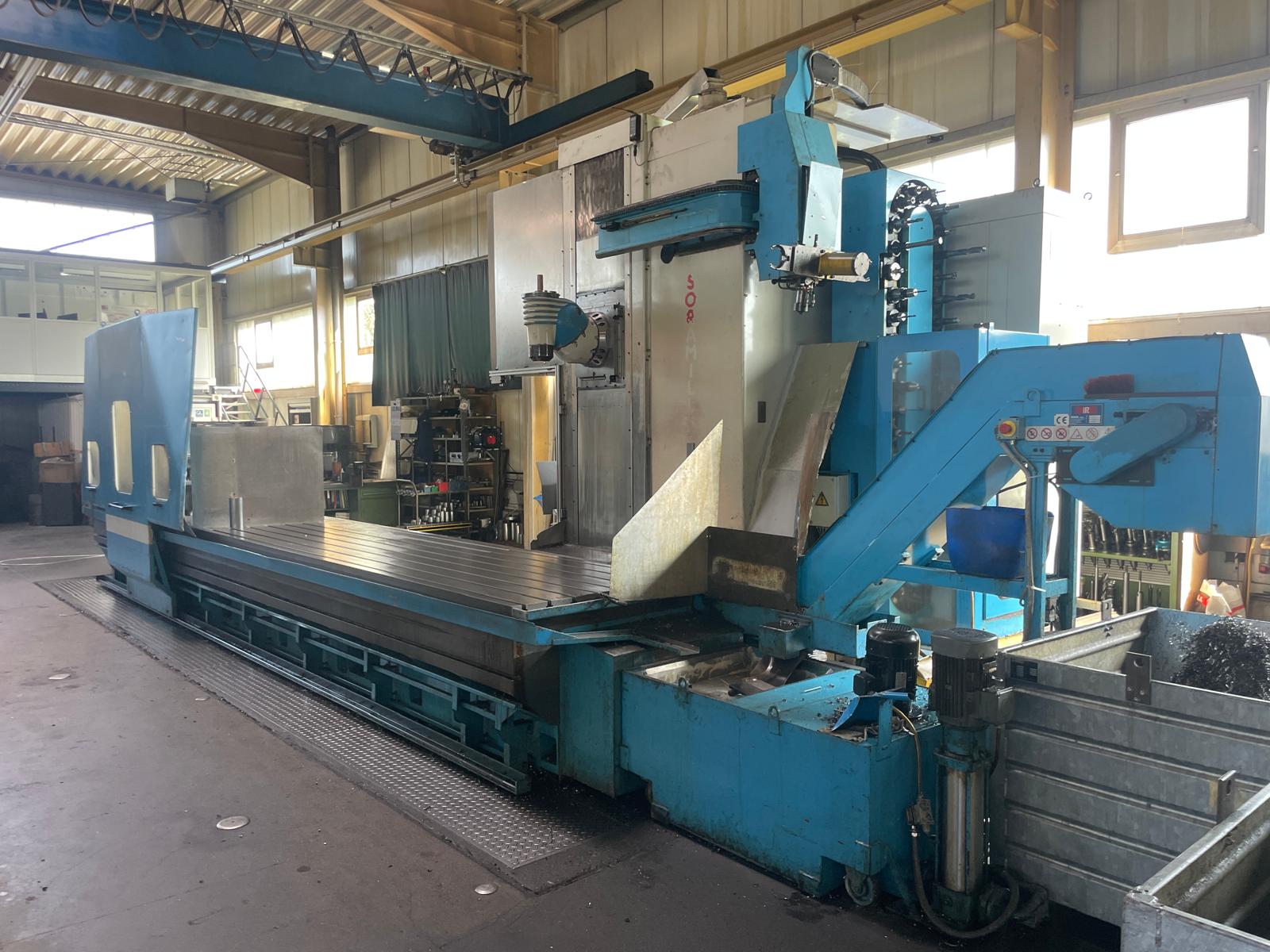
Germany’s aviation and aerospace sector maintains an exceptionally dense fleet of large-format CNC machines. With every shift to a new component family, every engine-program transition, machines come free that often stay productive for a long time with the next operator in the supply chain. We’ve bought from this segment for years, across Germany, with a focus on the four major aviation clusters in Hamburg/northern Germany, Bavaria, Baden-Württemberg, and Saxony.
Initial assessment, Tier 1-standard confidentiality, organised heavy-lift transport, and verified export-control compliance under the Dual-Use Regulation (EU 2021/821) and, where applicable, ITAR.
Germany’s aviation and aerospace industry at a glance
Germany is one of the three largest aerospace nations in Europe, after France and the United Kingdom. The industry association BDLI (Bundesverband der Deutschen Luft- und Raumfahrtindustrie) represents a large share of the German aviation and aerospace industry, from the major OEMs to specialized mid-sized suppliers. The industrial structure is clearly clustered:
Northern Germany — Hamburg, Stade, Buxtehude. The Airbus plant in Hamburg-Finkenwerder is a central site of the region. This is where the lines for the A320 family, the A350, and large-module pre-assembly are located. Suppliers in the wider area: Diehl Aviation, MT Aerospace, Aircraft Philipp. A strong presence in large-format structural assembly (composite and aluminum structural components).
Bavaria — Munich, Augsburg, Ottobrunn. Engine manufacturing at MTU Munich, military aviation at Airbus Defence and Space in Manching, and Airbus Aerostructures in Augsburg. This is where you find the most multitasking lathes for engine components (Mazak Integrex e-series, WFL Millturn) and HMCs for engine housings.
Baden-Württemberg — Friedrichshafen, Immenstaad. ZF Luftfahrttechnik Friedrichshafen is the central site of this smaller but active cluster on Lake Constance.
Saxony — Dresden, Chemnitz. The Dresden engine-technology cluster, home to the Fraunhofer IWS and several Tier 1 suppliers. Focus: additive manufacturing combined with high-precision CNC finishing; correspondingly high density of 5-axis HSC machines with long travel ranges.
Secondary clusters: Bremen (Airbus Defence and Space, OHB System), Oberpfaffenhofen near Munich (space), and Wolfsburg-Salzgitter (Airbus suppliers within the VW Group environment).
Typical machine classes in the aerospace segment
| Machine class | Typical models | Main application |
|---|---|---|
| Large-format 5-axis machining centers | DMG MORI DMU 125 P duoBLOCK, DMU 210 P, Hermle C 52/C 62/C 650, Fooke Endura, Pama Speedram | Titanium structural components, engine components |
| Gantry and portal milling machines | Zayer KMU, Waldrich Coburg PowerTec, Forest Liné | Large structural components, wing spars, fuselage fixtures |
| Moving-column milling machines | Soraluce FS/FR/FP/SLP, Zayer Kairós, Correa Rapid, Lagun Gantry | Mid-size structural components, component-family changeovers |
| Multitasking lathes | Mazak Integrex e-series, DMG NTX 2000/3000, WFL Millturn M/G series | Engine discs, engine shafts, rotationally symmetric parts |
| 5-axis universal milling machines | Mikron HSM 800 LP, Hermle C 42 U Dynamics, GROB G-series | Interior fit-out |
| Deep-hole drilling machines | TBT, Auerbach, ZB-Maschinen, NK-Bohren | Engine shafts, deep bores in landing-gear parts |
| Large boring mills | Skoda WHN, Pama Speedram, Soraluce TR, Juaristi | Engine housings, large gearbox components |
| Hard-machining grinding machines | Mägerle MFP, Studer S41, Kapp Niles | Turbine blades, bearing surfaces |
What makes this industry different when it comes to selling
Export-control screening comes first. Before an aerospace machine purchase becomes concrete, we check the applicable export-control situation. Three regulatory frameworks are relevant:
- The EU Dual-Use Regulation (EU 2021/821) with Annex I as the control list. Certain 5-axis machines with accuracy below defined thresholds fall under a licensing requirement.
- ITAR (US Munitions List, 22 CFR Part 121) for machines with US-origin components, or machines explicitly used to produce ITAR-controlled parts.
- EAR (US Export Administration Regulations, 15 CFR) with the Commerce Control List.
We check this before making an offer, if needed with foreign-trade specialists and a request to the German Federal Office for Economic Affairs and Export Control (BAFA). The result feeds into the offer — if the target market is restricted, the valuation is lower than in a case with unrestricted sale potential.
Aviation-authority documentation travels with the machine. Maintenance history, geometry inspection reports, calibration records, spindle-hours logs. These records move with the machine to the next buyer. They’re not strictly required under aviation law — but they significantly reduce the recommissioning cost for the new operator and make the machine more attractive for other certified production environments.
Confidentiality toward OEMs. Tier 1 contracts often include clauses that prohibit publishing manufacturing methods or machine configurations. We honor them — we sign a standard confidentiality agreement before the first data is shared. No photos in marketing material, no references to end customers, no description of parts produced.
Component-family programs on the control are sensitive. CNC programs for Airbus, Boeing, or Rolls-Royce parts are highly sensitive intellectual property. We clear the control’s memory together with you before pickup, documented in writing. For networked machines, we disconnect the network beforehand; interfaces to the CAM system (Siemens NX, CATIA, Mastercam) are deactivated.
Heavy-lift transport experience. Aerospace machines are often large-format — bed lengths over 12 m, weights over 50 t, attachments extending well beyond the machine’s base footprint. Standard transport isn’t sufficient. We coordinate permits, escort vehicles, and partial disassembly where needed. More at gantry and large-format milling machines.
Special considerations in aerospace buying
Spindle history is critical. Aerospace machining of titanium and Inconel is mechanically demanding. We typically request a spindle lifecycle log and check runout, vibration behavior, and bearing temperature under load on-site. A spindle with a heavy Inconel-machining history is valued conservatively, even if the hour count looks modest.
Geometry inspection is required. For 5-axis machines used in certified aerospace production, the geometry requirement (positioning tolerance, roundness, taper) sits well above the industry standard. We request the most recent geometry report (laser interferometer, ballbar) and carry out our own on-site measurement. A machine with documented, in-tolerance aerospace geometry typically achieves a 15 to 25% premium over the valuation of a geometrically uncertified machine of the same type.
B-axis design matters. For multitasking lathes, the B-axis (swiveling milling axis) is the most valuable component. Machines with an HSK-100A or HSK-125A B-axis for heavy machining are valued significantly higher on resale than those with ER or HSK-A63 interfaces.
On-site inspection takes longer. For standard machining centers, 90 minutes to half a day is enough for the inspection. For large aerospace machines, we plan for a full day — spindle diagnostics on the main spindle plus the B-axis, geometry checks, spindle-hours and error-log readout, tool-magazine review, palletization and automation check, and the control’s software version.
What we especially like to buy from aerospace fleets
- Large-format 5-axis machining centers with Heidenhain: DMG MORI DMU 125 P duoBLOCK, DMU 210 P, DMC 125 U duoBLOCK, DMU 160 P duoBLOCK — the best liquidity in the secondary market. Hermle C 52, C 62 for mid-size structural components.
- Gantry and moving-column milling machines: Zayer KMU, Forest Liné Gantry, Pama Speedram, and Soraluce FS/SLP (moving column). More detail on our Soraluce page.
- Multitasking lathes: Mazak Integrex e-1060V, e-1250V, e-1850V, DMG NTX 2000/3000/4000, WFL Millturn M65/M80/M120, Okuma Multus U3000/U4000.
- Deep-hole drilling machines: TBT ML series (ML300/ML500), Auerbach for deep bores.
- Hard-machining grinding machines: Mägerle MFP, Studer S41, Kapp Niles ZE gear grinders, Reishauer RZ series.
- Large boring mills: Pama Speedram, Skoda WHN, Soraluce TR, Juaristi MDR-X for engine housings.
Process for an aerospace purchase
- Confidentiality agreement. We sign a standardized NDA before any data is shared.
- Export-control pre-screening. We check the applicable EU Dual-Use/ITAR/EAR status based on brand, model, and end-customer context.
- Machine data + maintenance history. You provide model, year, spindle hours, control system, the most recent geometry and spindle inspection, and a list of component families (anonymized on request).
- Non-binding valuation, accounting for the export-control status.
- On-site inspection (one day). Spindle diagnostics, geometry, control audit, tooling and magazine check, control backup in preparation for deletion.
- Offer. Valid for seven days, Tier 1-grade confidential.
- Contract, payment, disassembly, and heavy-lift transport. Funds received in your account before disassembly begins. Control deletion documented. Transport with a permit from the competent road traffic authority and escort vehicles.
Request a confidential valuation of your aerospace machines. Initial assessment — export-control compliant, Tier 1-confidential, in writing.