
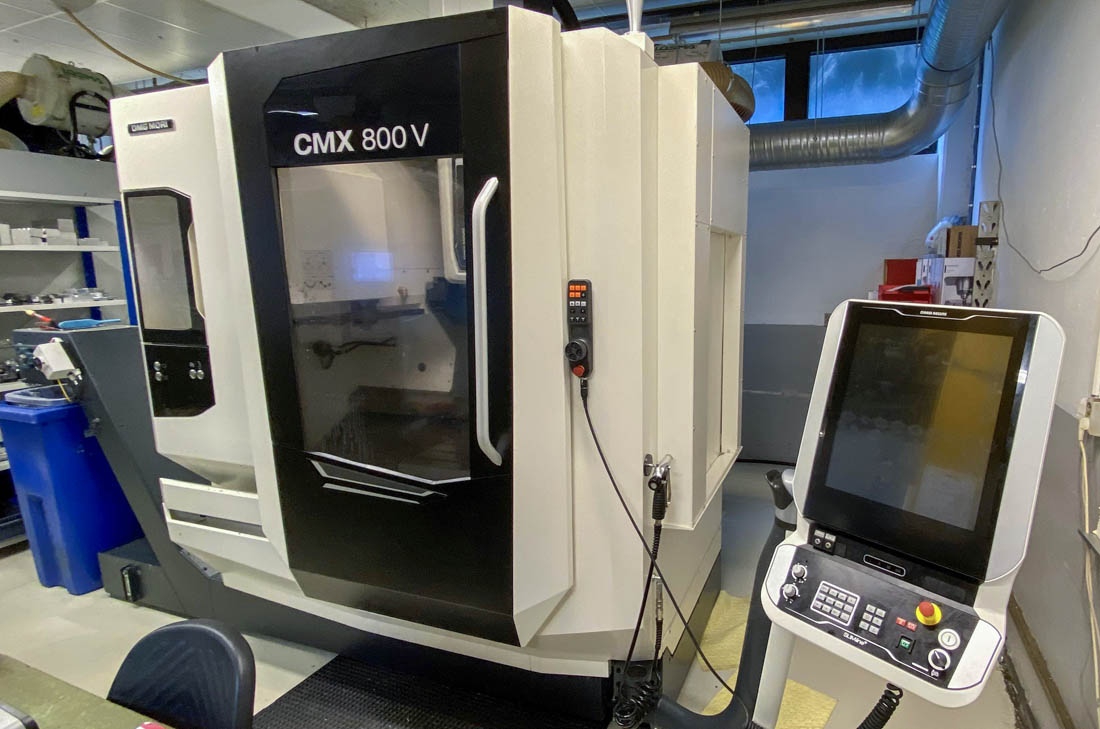
You want to know what your CNC machine tool is worth today. Not the book value from a depreciation schedule, not the list price from a five-year-old brochure, but the real proceeds you could realize from a sale in the next few weeks. This article describes how we arrive at that figure — step by step, with the factors that actually matter, and without the usual marketing gloss.
We value several hundred CNC machine tools every year — milling machines, lathes, machining centers, grinding machines, EDM, large-format equipment — for sellers around the world. The valuation is free and non-binding. It commits you to nothing; you get a realistic price range to work with however suits you.
The four factors that decide the value of a used CNC machine
Several variables feed into a complete valuation of a used CNC machine tool — the following four carry the most weight. Knowing these four factors for your machine lets you sanity-check any valuation you get from us or another buyer yourself.
1. Brand and model
The single biggest factor. A Hermle C 32 U with Heidenhain TNC 640, built in 2018, with 7,000 spindle hours, currently sits in the range of roughly €95,000 to €130,000. A technically comparable 5-axis machine from a standard brand with identical specs is more likely to fall between €35,000 and €55,000. That difference — a factor of two to three — isn’t marketing; it’s measurable secondary-market resale value.
Premium segment with the strongest value retention: Hermle, DMG MORI (particularly the German DMU/DMC and NHX lines and the Japanese NLX/NTX lines), Mazak Integrex and Variaxis, Okuma Multus and MB, Studer cylindrical grinders, pre-merger Mori Seiki machines (before 2013).
Solid mid-range segment: Haas, DN Solutions (formerly Doosan), Hyundai-Wia, Matsuura, Hurco, Mikron, Spinner.
Industry specialists with their own market: Soraluce and Nicolás Correa for large-format milling machines, Reiden for Swiss precision, Studer for cylindrical grinding, ONA for die-sinking EDM, Timesavers for sheet-metal band grinding.
Brands we inspect but generally value conservatively: Chinese mass-market brands, older Eastern European manufacturers without an active spare-parts supply, regionally limited brands with no international service network.
2. Control generation
On a premium brand, the control can shift the value by 15 to 25%. A Hermle with Heidenhain TNC 640 is noticeably more sought-after at resale than the same machine with iTNC 530 — even with identical mechanics. A DMG MORI with CELOS and TNC 640 sits at the top of the market range; the same machine with an older control sits at the bottom.
The current standard controls with the highest resale appeal:
- Heidenhain TNC 7 and TNC 640 for milling machines — the international standard in moldmaking, aerospace, and medtech
- Siemens 840D sl for machining centers, HMCs, and multitasking machines
- Fanuc 31i and 32i for lathes and production-oriented milling
- MAZATROL SmoothX, SmoothG, SmoothAi for Mazak machines
- OSP-P300/P500 for Okuma — the only major proprietary control besides MAZATROL that commands a resale premium
Older generations such as iTNC 530, Heidenhain TNC 426, older Siemens 810D, or older Fanuc 18i/21i reduce the resale price compared with the current generations — not because they’re poor controls, but because the end buyer factors in higher integration cost into a modern shop environment.
3. Spindle hours and maintenance history
Spindle hours are an important factor, but not the most important one — and without maintenance context they’re only half the story. A Hermle C 32 U with 18,000 hours and a complete maintenance history is worth more than the same machine with 6,000 hours and no documented maintenance, because the risk from a buyer’s perspective is lower in the first case.
Reference ranges we use internally:
- Under 5,000 hours: very low — typical for toolmaking, high-precision moldmaking, intermittent use
- 5,000 to 12,000 hours: normal for single-shift workshops with mixed utilization
- 12,000 to 20,000 hours: intensive — two-shift operation, series production, frequent use
- Over 20,000 hours: very intensive — usually three-shift or continuous production; a spindle diagnostic before sale is advisable
How to read spindle hours: on Heidenhain TNC 640, via the MOD key → “Machine parameters” → “Spindle hours.” On Siemens 840D sl, via the diagnostics menu → “Tool and spindle overview.” On Fanuc, in the maintenance menu under “Spindle Status.” On MAZATROL, under “Maintenance Menu” → “Operation Status.” If you’re unsure: photograph the relevant screen — we can read the counter off the photo.
For more detail on how spindle hours factor into the valuation, see our guide to spindle hours and CNC price.
4. Equipment and options
Identical machines with different equipment can have very different values — sometimes 30 to 50% apart. The main price drivers:
- Extended tool magazine (60, 90, 120 pockets instead of the base 24–32)
- Through-spindle coolant (TSC), preferably high-pressure (40 bar and above)
- Pallet system (Hermle RS 05-2, HS flex; DMG PH 150, PH 300; Mazak Palletech) — can raise the value of the whole installation by 25 to 60% over the standalone machine
- Measuring system (Renishaw OMP, Blum, integrated workpiece and tool probing)
- Automation (Robo2Go, external robot cell, bar feeder for lathes, automatic tool change to the spindle)
- Trunnion tables (high-accuracy NC rotary axis, Heidenhain RCN) on classic 3-axis machines
- High-frequency spindles above 18,000 RPM for HSC applications
- HSK tool holders instead of BT/SK on the same machine
Our valuation process — step by step
The whole valuation and offer process follows a fixed sequence. We do it this way because we handle several hundred valuations a year, and only a consistent process can guarantee realistic prices.
Step 1 — Data collection (you, about 10 minutes)
Send us by email, WhatsApp, or through the valuation form:
- Make, model, year
- Photo of the nameplate (with serial number)
- Photo of the CNC control screen (the main menu is enough — we can see the control type and version)
- Photo of the machine’s exterior (full view)
- Spindle hours (photographed from the control is fine)
- Current operating condition (in production / decommissioned / not operational)
- Location (postal code is enough for the logistics calculation)
Optional but value-increasing: maintenance log or history, list of extra options, most recent inspection report if one exists.
Step 2 — Market comparison (us, internally)
Our valuation team matches the machine data against three sources:
- Our own transaction history: what have we actually paid for comparable machines in the last 12 to 18 months — and at what price did we resell them?
- European B2B trading platforms: current listings for the same brand, the same model, similar build years. We filter out fantasy prices from machines that never actually sold.
- Demand from our network of end buyers in 15+ countries. Which country is actively asking for exactly this configuration right now?
The comparison produces a realistic resale range. Our purchase price sits below that — we have to justify the gap with logistics, upfront financing, storage, technical refurbishment, and our own margin requirement. How large that gap is in a given case depends on those factors.
Step 3 — No-obligation valuation (you receive it)
You get, in writing:
- A concrete price range (e.g. “€70,000–85,000”)
- The assumptions the range is based on (spindle hours, control, condition)
- What would shift the price up or down
- Whether a site visit makes sense to tighten the valuation
This valuation is non-binding for both sides. Use it to compare other offers, take it as an internal talking point, or ignore it entirely — all fine.
Step 4 — Site visit (optional, free)
For machines with a resale value above roughly €60,000, we typically schedule a site visit before making an offer. What we do on site:
- Spindle diagnostic — runout measurement at the tool holder (HSK or BT/SK), vibration measurement at idle across various speeds, acoustic check, temperature measurement of the spindle bearings under load
- Guideway and axis inspection — visual inspection of the linear guideways, measurement of axis play, check of lubrication
- CNC control read-out — full spindle hours, error log, diagnostic page
- Tool magazine review — number of pockets, condition of the tool holders, changer function
- Option verification — TSC pressure, measuring systems, pallets, automation
The site visit takes anywhere from 90 minutes to half a day, depending on machine size. You pay nothing — even if no deal ends up happening.
Step 5 — Our offer
The no-obligation range becomes a concrete figure. Our offer includes:
- Final price (e.g. €78,500)
- Payment method (typically bank transfer)
- Payment date — agreed in writing, confirmed in your account before disassembly begins
- Pickup date — a specific date or a week-long window
- Transport responsibility — we organise dismantling, loading and transport; whether these are included in the price is stated explicitly in the offer
If you accept our offer, we agree on payment and pickup together and record the details in the purchase agreement.
Which documents help you achieve a higher price
The valuation is a combination of market data and risk assessment. The less risk the buyer carries, the closer to the top of the market range the offer sits. These documents noticeably reduce that risk:
Maintenance log or history. Continuous documentation of all maintenance intervals, oil changes, filter changes, and spindle inspections over the machine’s lifetime. On DMG MORI, Hermle, and Mazak machines these logs were often included at delivery — if the original is still sitting in an office somewhere, dig it out. Machines with a complete history typically land 8 to 15% above the midpoint.
Original receipts or purchase agreement. The original purchase contract with price, delivery date, and the original equipment list. Helps us identify the machine unambiguously and compare original options against current equipment.
Most recent inspection report. If the machine was geometrically measured in the last 12 to 24 months (laser interferometer, ballbar, Renishaw measurement), include the report. Documented geometry within manufacturer tolerances pushes the valuation noticeably upward.
Safety inspection records. The annual electrical inspection under DGUV V3 (formerly BGV A3) and, where applicable, the machine safety inspection. Machines with a current inspection record are immediately ready for use by the end buyer — a benefit we can pass on to you.
Photo documentation of recent maintenance. A newly installed cooling system, a retrofitted control, a spindle replacement in recent years — with photos and ideally an invoice. Every documented investment from the last 3 to 5 years shows up in the valuation.
Declaration of conformity and machinery directive documents. For machines placed on the market after 1995 (Machinery Directive 89/392/EEC or later 2006/42/EC), the EC declaration of conformity. For machines from before that period, CE marking isn’t mandatory, but it helps at resale under EU law.
No-obligation valuation vs. our offer — the crucial difference
These two terms often get blurred in everyday use. But they mean very different things:
No-obligation valuation: a price range, free, in writing, delivered after receiving your data. It commits neither you nor us. It’s a realistic market orientation. Share it, compare it, or ignore it.
Our offer: a concrete figure with the terms attached — payment method, pickup date, transport responsibility. If you accept it, we agree on payment and pickup and record the details in the purchase agreement.
Why the two-stage process? Because the no-obligation valuation is built on photos and data, and our offer additionally builds on a site inspection for higher-value machines. We don’t want to quote you a number we later have to cut by 20% — and we equally don’t want to quote you a number we can’t stand behind. The two-stage structure protects both sides.
Why our valuations hold up
We handle several hundred valuations a year — from single machining centers to complete factory clearances. That volume of experience is the real reason our valuations sit closer to actual market price than those of an occasional buyer or an online platform working from list prices:
- Real transaction data, not catalogue prices. List prices and general market studies show trends — not actual sale prices. We know the actual prices, because we paid them ourselves.
- End-buyer network in 15+ countries. We know which market is paying right now — and how much.
- No financing contingency; we buy directly. We buy without a financing contingency. That means we don’t have to factor in commission discounts, and we don’t accept an open-ended “we’re still looking for a buyer” situation. The price we quote is the price you get.
- Consistent process. The same methodology for a €25,000 machine as for a €400,000 installation. That rules out valuation errors driven by gut feeling.
For more on the market data behind these figures, see our guide to Germany’s used-machinery market and the overview of the six value factors of a used CNC machine.
What to do if the valuation comes in lower than expected
It happens — especially when the original expectation was based on the purchase price or book value rather than the real secondary market. Three sensible steps:
- Ask for the specific assumptions. We’re happy to explain which key figures our range hinges on — control generation, spindle-hour rating, market demand in your region. Sometimes it turns out an option wasn’t captured, or the spindle hours were reported incorrectly.
- Compare it against two or three other offers. Serious market participants typically land within a range of 10 to 15% of each other. If one offer is significantly higher, that’s often a middleman who does not buy directly and has to pass your price along — see our guide to selling CNC machines at the best price.
- Talk to us about the reasoning. Send us the comparable offers and documents you have; we are happy to go through the figures with you. See How it works for the next steps.
Request a free valuation for your CNC machine. We’ll get back to you with an initial assessment — no obligation, in writing, confidential.