
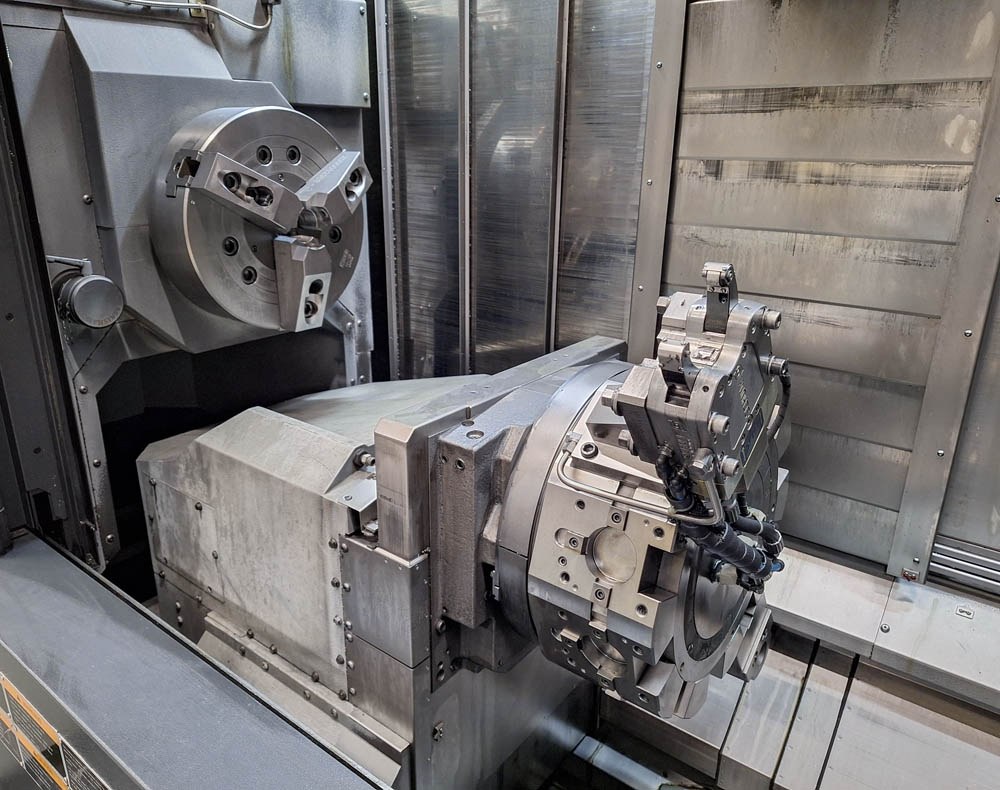
If you need to sell a CNC lathe, we’ll give you a no-obligation initial assessment; when we buy directly, with no commission and with payment by bank transfer before pickup. The installed base of CNC lathes is large, and a meaningful share changes hands every year — which makes the lathe the machine tool with the highest liquidity on the secondary market.
2-axis CNC lathes (slant-bed)
The workhorse of machining shops. Two axes (X, Z), tailstock, turret with 10–12 positions. General production of cylindrical parts across all industries.
Top-tier reference brands: DMG MORI (CLX, CTX), Mori Seiki (CL, SL series), Mazak (Quick Turn), Okuma (LB-EX), DN Solutions/Doosan (Lynx). Upper mid-range brands: Haas (ST series), Tsugami (Swiss-type precision lathes). Value retention after 10 years ranges between 25% and 45% of the new price, depending on brand and maintenance condition.
C-axis turning centers
Add milling capability and angular interpolation to the base lathe. The turret houses driven tools that enable secondary operations without a machine changeover: radial drilling, slot milling, thread milling. On the used market, the C-axis version is usually valued higher than the plain 2-axis lathe.
Y-axis lathes
A step beyond the C-axis. The Y-axis enables off-center machining: eccentric slot milling, offset radial drilling, complex contouring in a single setup. Key brands: DMG MORI (CLX/CTX series), Mori Seiki (NL 2500 SY, NL 3000 Y), Mazak (Quick Turn with Y), Okuma (LB3000 EX-II MY), DN Solutions (Puma 2600SY).
Multitasking lathes (turn-mill)
The high end of CNC turning. They combine full turning with 5-axis milling, a B-axis (milling spindle tilt), and often a lower turret and sub-spindle. They replace two or three machines in a single setup, reducing cycle times and re-clamping errors.
Reference models: DMG MORI (NTX 2000, NT4250/NT4300, CTX TC), Mori Seiki (NL 2500 SY, NTX series), Mazak (Integrex i-series), Okuma (Multus B/U), Nakamura-Tome (Super NTJX, NTY3, NTJ series). A high-end multitasking machine usually commands significantly more on the secondary market than a 2-axis lathe of the same brand and age.
Heavy-duty and large-diameter lathes
For workpieces with large diameter and length: rail axles, hydraulic cylinders, industrial rollers, energy components. Turning diameters from 800 mm to over 3,000 mm. Distances between centers of 2 to 12 meters.
Brands: Wohlenberg (MK series — the German reference for heavy, large-diameter lathes with an active international market), Pittler (VDM series), Poreba, Škoda Machine Tool, Hankook. The market for heavy lathes is narrow but solid: few local buyers, but our international network covers energy workshops, shipyards, and rail-maintenance operators across Europe. For high-value, large-format machines, we sell through our buyer network to find the right buyer.
Automatic and CNC multi-spindle lathes
Series production of small and medium parts. Short cycles, high volume, ideal for fasteners, watchmaking, medical technology, and automotive.
- CNC single-spindle Swiss-type: Citizen (Cincom L series), Star (SB/SR series), Tornos (SwissNano, Swiss GT), Tsugami (B0205 series — Japanese Swiss-type high-precision lathes with an active market in Europe).
- CNC multi-spindle: INDEX (MS series), Traub (TNS series), Schütte, Gildemeister (GMC/Sprint).
INDEX and Traub multi-spindle machines may be the machines with the best residual-value-to-age ratio on the market.
What information do we need for an offer?
To put together a precise initial assessment, we need: brand and model, year built, CNC control (make and model), maximum turning diameter, bar capacity, axis configuration (C, Y, sub-spindle), spindle hours if available, general condition (working / known fault), and photos of the control, turret, and general condition of the machine.
Faulty, decommissioned, or undocumented lathes
We assess case by case, when the mechanics and brand allow recovery via retrofit or parts sale. Common faults we check:
- Main spindle with play or abnormal vibration.
- CNC with communication errors or a faulty screen.
- Turret with indexing problems or a damaged sensor.
- Hydraulic systems with leaks.
“A lathe with a damaged spindle isn’t scrap: it’s a Japanese or European precision bed with one replaceable component. We technically assess every defect to separate actual repair cost from the machine’s residual value. In many cases, the end buyer already has the replacement spindle in stock.”
— Lucas Agustí, COO and co-founder of webuyyourmachinetools.com
If the diagnosis matches a real buyer, we close the transaction; if there’s no channel at an economically viable price, we say so without beating around the bush. The retrofit market remains active for solid base frames from recognized brands.
Request your quote now
Send us the basic data for your CNC lathe (brand, model, year, spindle hours, photos) and get a no-obligation valuation. No commission when we buy directly, with an offer and payment by bank transfer before pickup.
Get in touch now and get a no-obligation initial assessment
Value factors by brand and machine type: Price of a used CNC lathe. Selling several lathes or a mixed portfolio? See also Plant closure and machinery liquidation.