
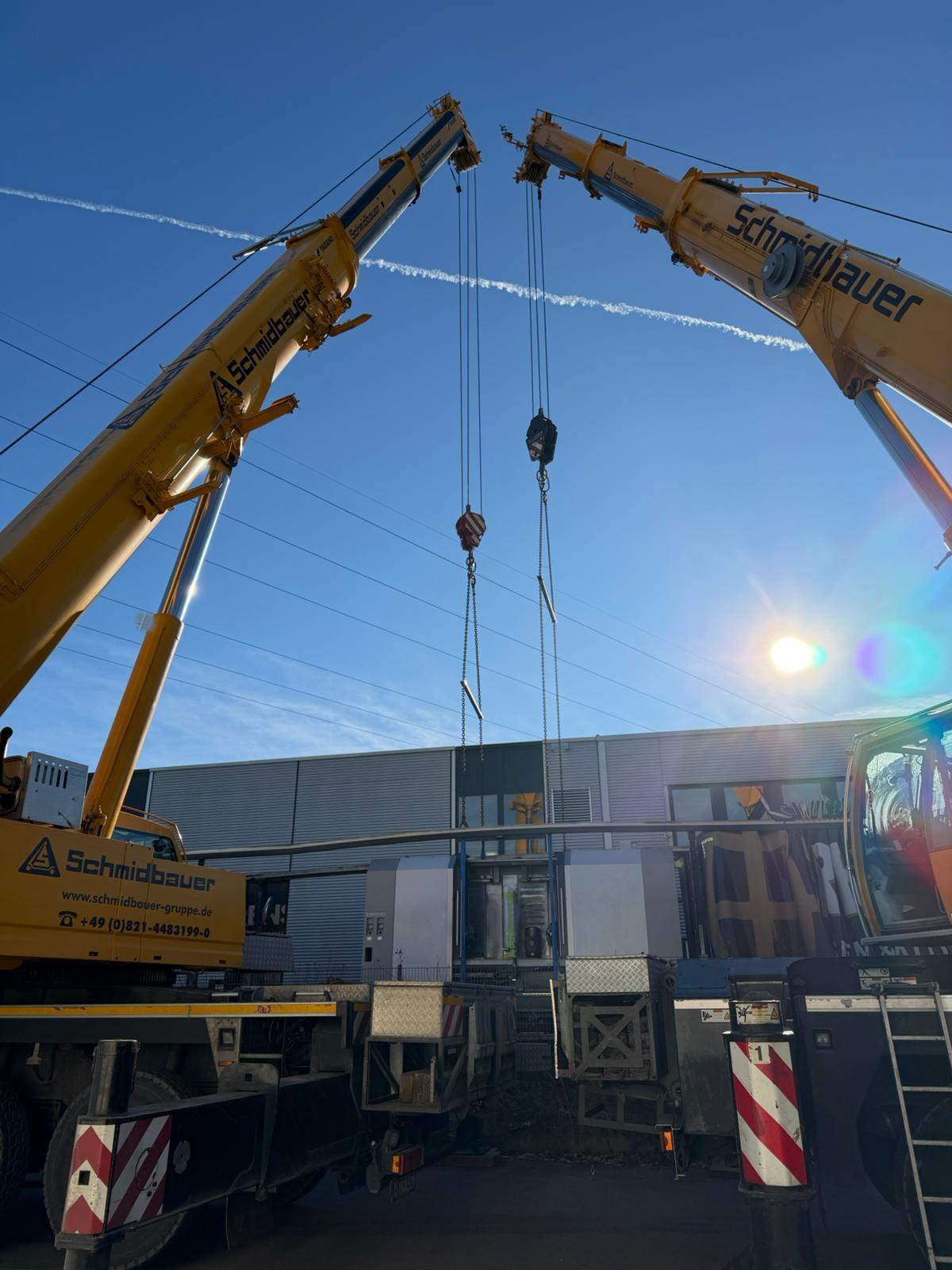
A plant relocation is one of the most operationally demanding events in manufacturing: production has to keep running at the old site right up until the last possible moment, while the new site’s infrastructure is being prepared at the same time. The machine fleet sits at the center of that logistics puzzle — and every wrong call costs time and money.
We help you decide with confidence: what do you take with you? What do you sell? And how do you coordinate it so the move isn’t weighed down by unnecessary transport costs?
The core question: take it or sell it?
Whether to move a machine or sell it comes down to a straightforward economic comparison:
Transport cost for a CNC machine (disassembly, crane, transport, reinstallation, recommissioning, geometry check): it depends on size, weight, and distance and can only be quantified with a concrete quote for the specific machine.
Market value of the machine: that’s the number we give you — free, based on real transaction prices.
If market value > transport cost: take the machine and keep using it at the new site.
If market value ≤ transport cost: sell the machine and, if it’s still needed, source a newer or used replacement at the new site.
That sounds simple, but in practice it’s often skipped: teams transport machines on reflex, because they’ve “always been there,” even when a rational assessment would show that transporting them costs more than buying new.
How the sale proceeds offset relocation costs
Selling the machines you leave behind is more than simple sorting: the proceeds can be applied directly against the transport cost of the machines that are moving to the new site. Depending on the value of the machines sold and the transport effort for the machines being moved, selling just a few surplus units can meaningfully cut, or even cover, the cost of relocating the rest of the fleet. The larger the share of machines you’re selling anyway, the more directly the move can be self-funded from your existing fixed assets — instead of tying up additional capital in relocation logistics.
Typical categories in the take-or-sell decision
Always take with you (high value, low transport cost, critical to production):
- 5-axis machining centers from Hermle, Röders, DMG MORI (newer generations)
- High-precision coordinate measuring machines
- Specialty machines that are hard to replace
- Machines with long lead times
Decide based on valuation (mid-age, mid-value):
- CNC lathes at the lower end of the price range
- Boring mills and older machining centers
- Laser and sheet metal machines (check case by case: fiber lasers often worth moving, CO2 often worth selling)
Usually sell (high transport cost relative to value):
- Conventional lathes and older conventional milling machines
- Large, heavy machines with low resale value
- Machines with end-of-life control systems (no replacement parts, no service)
- Peripheral equipment: older coolant systems, outdated conveyors, old measuring instruments
Coordinating alongside ongoing production
The common mistake in plant relocations: the machine sale gets pushed to the final week, when time pressure is highest.
The better model: we value the entire fleet 6–12 weeks before the planned move date. You decide what to sell based on our valuation. We agree on a pickup plan that follows the production schedule — machines that need to run until the end get picked up last.
That reduces stress and avoids rushed last-minute decisions.
Concrete steps for your plant relocation
Step 1 — Build a machine list: manufacturer, model, year built, control system for each machine. If you don’t have a complete list, we’ll come on-site and build the inventory ourselves.
Step 2 — Request a valuation: we deliver an initial assessment for every machine — market value plus an estimate of transport cost, as a point of comparison.
Step 3 — Decide and plan: you decide what to sell. We build a pickup plan that fits into your move schedule.
Step 4 — Execution: pickup and payment on schedule. You can focus on the move — the machines being sold leave your site on the agreed date.
If you also need a full facility clearance after the last production day, let us know — we’ll coordinate the rest of the wind-down and, on request, appoint a certified waste management contractor for anything with no remaining resale value, who will issue you the disposal records directly. More on that: industrial facility clearance. If the old site isn’t relocating but closing entirely: plant closure — sell the machine fleet.