
When a company closes (a plant closure or wind-down), we buy every machine in a single transaction: an initial response, a concrete, non-binding offer once we have reviewed the machines and, on a direct purchase, payment by bank transfer before we touch a single machine. Every day the machines sit in the facility costs money — rent, insurance, utilities, management time — so speed here is not a convenience but a price factor.
If you are instead selling your machine-building or plant-engineering business as a whole — with the buyer intending to continue it, not as a final closure — then selling a machine shop business is the better page: it covers the role of the machine fleet in a business sale, asset deal versus share deal, and the market valuation as a negotiating basis.
How do I sell machines from a plant closure?
One way to sell the machines of a plant closure is in a single transaction to a buyer who takes over the entire machine fleet. This is how it works with us:
- First contact: you briefly describe the business and the machine fleet by phone or email; the first response follows.
- Technical visit: we inventory every asset with photos and documentation and value it at its actual market value.
- Overall offer: a concrete, non-binding offer after review, broken down by asset or lot.
- Purchase agreement: the agreed price, a pickup schedule, and the payment arrangement; payment is made before pickup.
- Disassembly and pickup: we coordinate logistics and loading; the facility is usually cleared within 2 to 6 weeks.
Beforehand you should clarify two things: whether the machines are unencumbered (lease, security transfer — see the section on realizing the machines below) and how the sale is to be treated for tax purposes (tax advisor). Selling piece by piece through portals or an auction typically takes longer; what each additional month costs is shown by the worked example in the next section.
Plant closure: why speed matters when selling machines
Closing an industrial company is never an easy decision. Behind it are years of work, relationships with customers and suppliers, and often a family history. But once the decision is made — whether through the owner’s retirement, loss of profitability, a change in business direction, or another reason — the priority is maximizing the liquidation value with maximum speed and minimum ongoing cost.
From our own experience: industrial plant closures happen regularly in Germany, and most share a common thread — a fleet of machines that has to be liquidated within a set deadline, with an owner who isn’t a specialist in selling used industrial machinery and has a hundred other things on their mind at the same time.
The most common mistake in this situation is underestimating the economic cost of letting the liquidation process drag on.
The math of closing: what every month of delay costs
A worked example (rent follows the existing-stock rents for logistics space from the 2025 Realogis market analysis; insurance and utilities are assumed guide values, not market data):
- An 800 m² facility at €5.28–6.58/m² per month (average minimum to prime rent for existing logistics space, Realogis 2025): roughly €4,200–5,300/month rent
- Industrial insurance while assets remain on site: €600–900/month
- Minimum utilities (power, water, security): €400–600/month
- Total cost of keeping the facility active: €5,200–6,800/month
If liquidating machine by machine takes 4 months longer than a direct, single-transaction sale, the extra cost can run €20,800 to €27,200 — in facility costs alone — without counting the time of the manager responsible for the closure, who usually has other priorities at the same time.
A fast direct sale, even at a somewhat lower price than a theoretical piece-by-piece sale but closing in 3 weeks, is in most cases economically far better than an optimized liquidation that drags on for 4–6 months.
What a plant closure means legally
A plant closure is the definitive end of entrepreneurial activity: the business isn’t just temporarily shut down but wound up legally, organizationally, and economically — the trade is deregistered, contracts are terminated, and the business assets, above all the machine fleet, have to be realized. Anyone planning a plant closure, or in the middle of one, faces a mix of deadlines, formalities, and the practical question of what happens to the machines. This guide takes you through the process, deadlines, the tax basics, and the realization of the machines — with a step-by-step checklist at the end.
Deadlines in a plant closure
A plant closure is not a single act but a sequence of deadlines that run in parallel and vary with legal form, contract situation, and headcount. The overview below lists the key statutory reference points — it is no substitute for legal or tax advice in an individual case.
| Deadline | Rule | Key point |
|---|---|---|
| Trade deregistration | Section 14 GewO | To be notified to the competent authority at the same time as the activity ceases. The law sets no fixed number of days but requires notification simultaneously with cessation. If the closure of the business is clearly established and deregistration doesn’t follow within a reasonable period, the authority can deregister the trade ex officio; late notification can be penalized as an administrative offense. |
| Commercial register deregistration (GmbH/UG; for merchants, OHG, and KG, the notification of the firm’s extinction applies) | Sections 65, 73, 74 GmbHG; Section 31 HGB | The dissolution is notified to the commercial register with notarial certification and announced by creditor notice in the Federal Gazette. A statutory one-year blocking period then runs: the remaining assets may only be distributed to the shareholders one year after the creditor notice — deletion from the commercial register follows only afterwards. |
| Retention of business records | Section 257 HGB, Section 147 AO | Books, inventories, and annual financial statements: 10 years. Accounting vouchers: 8 years (since 1 January 2025). Received and sent commercial and business letters: 6 years. The period starts at the end of the calendar year of the last entry — this obligation continues regardless of the date of the closure. |
| Termination of commercial lease | Section 580a BGB | For contracts of indefinite term, statutorily 6 months to the end of a quarter, with notice arriving by the third working day of the quarter at the latest — otherwise the effect shifts by another quarter. Fixed-term contracts expire as planned; early termination is usually possible only for good cause or by a termination agreement with the landlord. |
| Termination of employment contracts | Section 622 BGB | Basic notice period of 4 weeks to the 15th or the end of the month. If the employer gives notice, the period lengthens in steps with length of service. For larger workforces, co-determination rights of the works council and the mass redundancy notification obligation (Section 17 KSchG) may also apply. |
In practice that means: selling the machines and the official deadlines run side by side, not one after the other — you don’t have to wait until the trade is deregistered to sell the machines. What matters is keeping all deadlines in view early, especially the lease termination, because at 6 months it usually demands the longest lead time.
How a plant closure works: from inquiry to empty facility
The process is built for speed and transparency:
Day 1 — First contact: a call or email with a general description of the company and its machine fleet. Confidentiality from the first minute.
Days 2–5 — Technical site visit: our team visits the facility, inventories every asset with photos and documentation, and assesses the technical condition of the machines. There’s nothing special for the owner to prepare — we do the inventory work.
Days 6–7 — Overall offer: we present a concrete, non-binding offer after review, broken down by asset or lot. No pressure.
Week 2 — Contract signing: once you accept the offer, we sign a purchase agreement with the agreed price, a pickup schedule, and the payment arrangement.
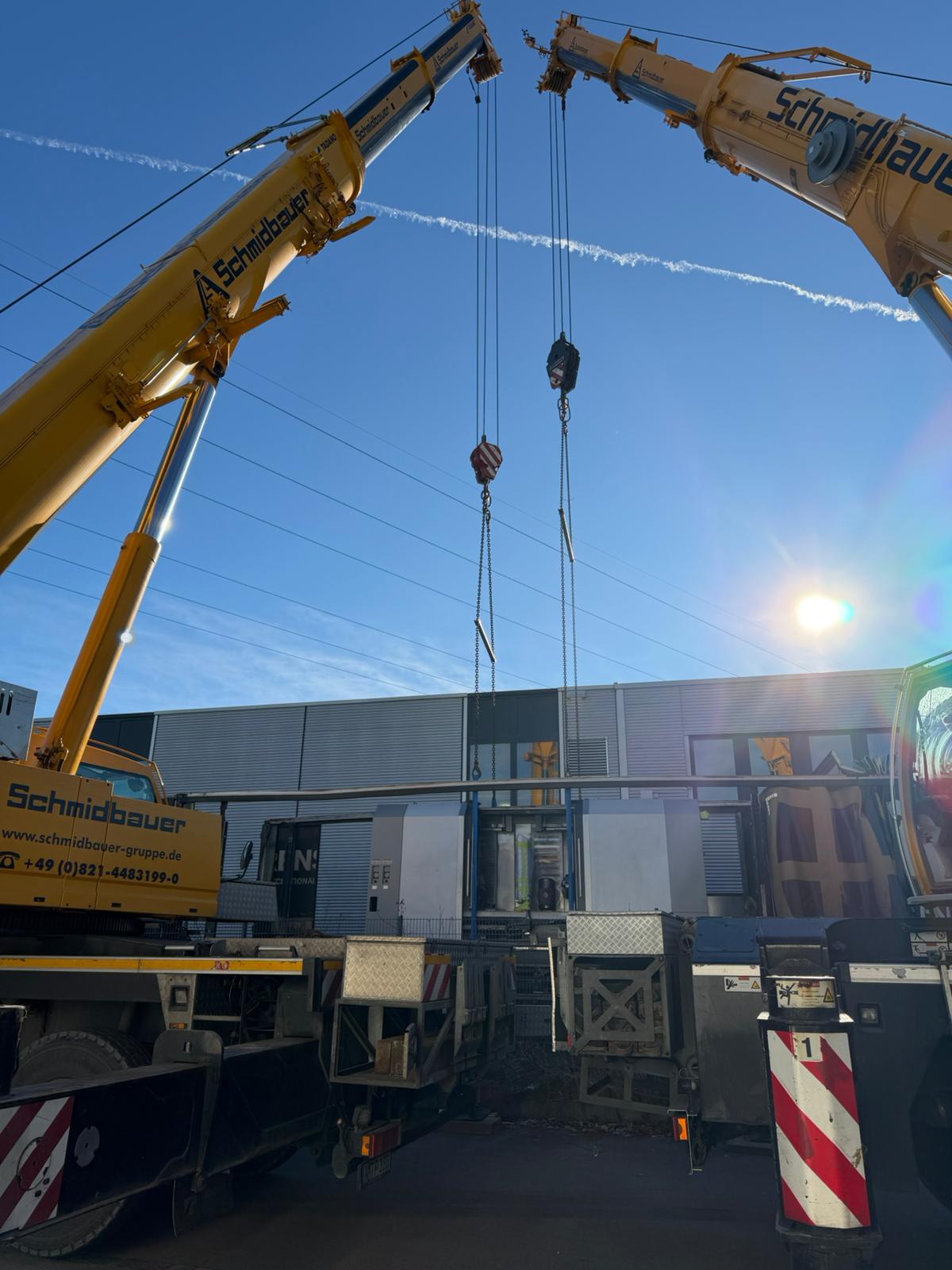
Weeks 2–6 — Disassembly and pickup: we coordinate the entire disassembly, loading, and transport process. You don’t need to organize anything — just grant access.
End result: an empty, swept facility and purchase invoices for the accounting closure. The disposal records are issued to you directly by the appointed waste management contractor.
Realizing the machines: what happens to them in a plant closure?
In this context, realizing the machines simply means: capturing their market value before the facility has to be cleared — by selling, not scrapping. Industrial machines are fixed assets on the company’s balance sheet. When closing, liquidating them has accounting, tax, and legal implications that a tax advisor should oversee. Our role is that of the buyer: we make an offer based on the market value and issue the documentation the closure process requires.
From a practical standpoint, there are three common situations:
Machines owned outright: the simplest situation. The owner can sell them directly with no restrictions. Our offer, our documentation, and our bank transfer are all you need.
Leased machines: the machine belongs to the finance company until the lease is settled. As part of the closure process, the lease needs to be closed out. We can help you calculate whether the machine’s market value exceeds the outstanding balance, and structure the transaction so the sale funds the payoff. See selling a machine still under lease.
Machines with other encumbrances: seizures, security transfers, or other registered liens need to be cleared first. Your legal counsel is the right contact for that part; we handle the purchase once the machines are unencumbered.
Taxes in a plant closure
Beyond the organizational side, a plant closure also has tax consequences for the business assets. At its core: when the business is given up, hidden reserves are revealed — the difference between book value and the actual selling value of the machines becomes visible for tax purposes. The resulting disposal or closure gain can be taxable. For sales of fixed assets you also have to check whether and in what amount VAT applies.
How high the actual tax burden is and what room for structuring exists depends heavily on the individual case — legal form, timing, size of the gain, and personal circumstances all play a role. This is not tax advice — consult a tax advisor for your individual case.
For the machine sale itself we need only basic documentation — company registration number and, where applicable, machine documentation and proof that the assets are unencumbered; the complete overview is in the checklist at the end of this page. For the accounting closure, we issue a complete purchase invoice for every fixed asset, with description, serial number, and price — the basis for writing the fixed assets off the balance sheet and for reporting the disposal result.
Pricing and valuation in a closure situation
Closing a company doesn’t automatically lower the value of its machines. A CNC milling machine in good condition is worth what it’s worth on the market, regardless of why it’s being sold. Our valuation follows the same criteria as any other purchase: real market price, based on current comparable transactions.
What can affect the price is the technical condition of the machines. If some machines have sat idle without maintenance for months during the closure process, they can develop problems that affect their value. That’s why we recommend starting the sale process as early as possible before the final closure, while the machines are still in working order.
The logistics key in a closure is a complete inventory with a facility layout. That lets us calculate the lifting equipment needed, the number of trucks, and the working days before we start.
A CNC machine that has sat idle for an extended period loses significant additional value compared with its worth in working condition. Timing is a real factor in deciding when to sell.
If the machine fleet comes from an insolvency estate, buyers additionally check ownership and absence of encumbrances, missing documents, the possibility of a test run, and the extra costs of dismantling and transport — that affects the price you achieve. How buyers vet such offers is described in the guide on our sister site usedcnc.de: What to look out for with machines from insolvency sales
Common cases we manage
Owner retirement with no successor: one of the most common triggers in German manufacturing. The owner has run their business for 30 years, wants to close it well and with dignity, and needs a trustworthy partner who values what they’ve built fairly. We handle these transactions with the respect they deserve.
Loss of the main customer: when a customer who represented 50–70% of revenue cancels or drastically cuts their contract, the company ends up with overcapacity that can lead to closure. The machine sale process can start before the formal closure to generate liquidity.
Change of business: the company isn’t closing, but is changing its line of business entirely, and the current machine fleet has no use in the new activity. We buy the entire fleet from the previous line of business.
Closing a subsidiary or branch: a parent company decides to close a facility or branch. The machines at that site need to be liquidated as quickly as possible. We manage the transaction with confidentiality toward third parties.
Closure of a plastics processor: injection molding machines are a valuation case of their own in a plant closure — clamping force, control, and shot count determine the value, not the usual CNC figures. Details on the valuation method under buying injection molding machines.
Closure of a business with sawing technology: band saws, cold circular saws, and sawing centers are also part of the machine fleet in many plant closures, especially in steel and metal construction businesses. Depending on the machine and the market, we either buy them or refer them to a buyer in our network.
Closure of a business with gear-cutting technology: hobbing, shaping, and gear grinding machines are part of the fleet of many gear and drive-technology businesses. Depending on the machine, we either buy them or refer them to a buyer in our network.
Why work with specialists in a closure situation
In a plant closure, time creates immediate costs: rent, utilities, insurance, and the uncertainty over tied-up assets add up over the weeks while the machines wait for a buyer.
Working with us solves the three problems of a closure at once: real market price (not a distress price), speed of resolution (weeks, not months), and minimal administrative work on your side — we organise disassembly, logistics and the appointment of the certified waste management contractor, and you get the disposal records directly from that contractor. If a high-value machine needs the right international buyer, we market it specifically through our buyer network, on a schedule agreed within your closure deadline.
“In a closure process, every week that passes has a measurable cost. We’ve seen companies spend 9 months liquidating their machines trying to maximize the price of each one individually, and end up with less than they would have made from a fast direct sale, purely because of the facility costs that piled up. Speed isn’t the enemy of price in a closure — it’s the ally.” — Marcel Brockmann, CEO and co-founder of MBR
Checklist: plant closure step by step
All the deadlines and documents from this page in one overview, in a practical order:
- Document the decision and set a rough timeline — depending on machine volume, plan 2–6 weeks for the machine sale (see the process above).
- Prepare trade deregistration: file it with the competent authority at the same time as you actually cease operations (Section 14 GewO).
- For a corporation (GmbH, UG): notify the dissolution to the commercial register with notarial certification, arrange the creditor notice in the Federal Gazette, and build the statutory blocking year into your timeline (Sections 65 and 73 GmbHG).
- Check the facility lease and terminate on time: for indefinite-term contracts, plan at least 6 months to the end of a quarter (notice by the third working day of the quarter at the latest, otherwise the end shifts by a quarter) — usually the longest deadline in the whole process (Section 580a BGB).
- Clarify employment contracts and notice periods for the workforce: basic period 4 weeks, staggered by length of service when the employer gives notice; for larger workforces, check the works council and mass redundancy notification (Section 622 BGB, Section 17 KSchG).
- Have the company registration number and power of attorney of the signatory ready for the machine sale contract.
- Assemble machine documentation, where available: manuals, technical data sheets, serial numbers — helpful but not required, since we identify the assets during the technical visit.
- Obtain confirmation that assets are unencumbered, if machines carry registered liens (seizures, security transfers).
- Confirm facility availability for the pickup phase and align it with the pickup schedule.
- Request purchase invoices for every fixed asset: the basis for writing them off the balance sheet and for reporting the disposal result.
- Ensure retention of business records: books, inventories, and annual financial statements 10 years, accounting vouchers 8 years, business letters 6 years — this obligation continues regardless of the date of the closure (Section 257 HGB, Section 147 AO).
- Clarify the tax treatment of the disposal gain with your tax advisor: coordinate hidden reserves and VAT on the asset sale in advance.
This checklist is no substitute for legal or tax advice, but it gives a realistic overview of what actually needs doing in a plant closure.
Also read about how our buying process works, and our page on industrial facility clearance if you also need the full disassembly and waste-coordination service handled end to end.
Request a free valuation for closing your company. We’ll be in touch, with full confidentiality from the first minute.