
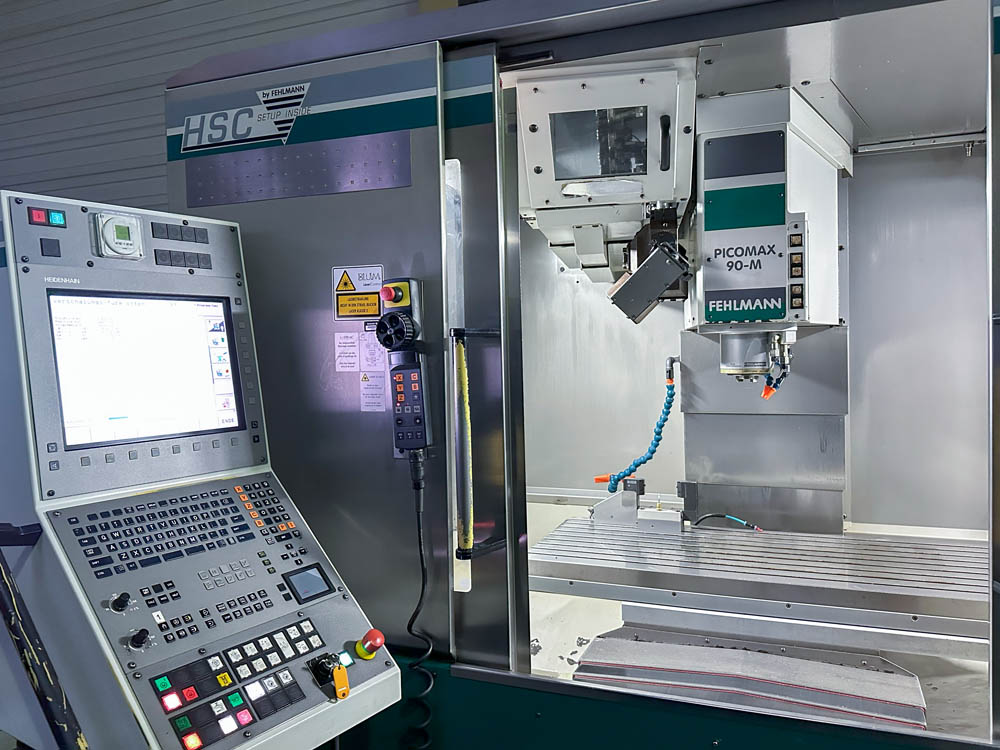
Germany is one of the world’s leading medtech locations, with an internationally high density of specialized manufacturers. Its machine fleet has its own characteristics: smaller batch sizes, significantly higher precision requirements, dense validation and documentation, and an active international secondary market among manufacturers producing under ISO 13485 or 21 CFR 820.
We regularly buy Swiss-type lathes, micro-machining centers, high-precision grinding machines, micro-EDM equipment, and the associated measurement and inspection equipment from this segment. Initial assessment, confidential handling during site closures, and complete handover of the machine-related validation documentation.
German medtech in numbers
Tuttlingen, with over 400 companies based there, is a major medtech location. Within a 20-kilometer radius of this town on the Danube, Aesculap (B. Braun) and KARL STORZ manufacture alongside hundreds of smaller specialist producers — from scalpel blades to navigation-capable spinal screws. The regional machine density per employee is the highest in Germany.
Hamburg and northern Germany. Olympus Surgical Technologies Europe, Eppendorf, Drägerwerk, plus the Lübeck medtech cluster. Focus: endoscopy, lab automation, and surgical instruments.
Munich-Erlangen-Nuremberg. Siemens Healthineers (Erlangen), Brainlab (Munich), and numerous Tier 1 suppliers for imaging, surgical robotics, and implantology. Several mid-sized implant manufacturers with a Swiss-type lathe focus are also based in this southern German region.
Berlin-Brandenburg. B. Braun Berlin, Biotronik, plus several specialized suppliers. Focus: pacemakers, stents, drug delivery.
Heidelberg-Mannheim. Roche Diagnostics, Heidelberg Engineering, plus numerous university-hospital spinoffs. Focus: diagnostic instruments, ophthalmology, oncology.
Typical machines we buy
| Class | Models we especially like to see | Typical application |
|---|---|---|
| Swiss-type lathes | Tornos Swiss DT/GT/MultiSwiss, Tsugami SS/B, Star SR/SV | Implant screws, pedicle screws, bone screws, mini-instruments |
| 5-axis micro-machining centers | Fehlmann Picomax 60/95, Kern Pyramid Nano/Micro, Willemin-Macodel 408MT, Yasda YBM | Hip/knee implants, vertebral-body replacements, dental components |
| High-precision cylindrical grinding | Studer S20/S31/S33, Voumard, Kellenberger | Implant shafts, drill and reamer tools |
| Die-sinking EDM | Sodick AG40L/AG60L, Mitsubishi EA8/EA12 | Stent geometries, micro-channels, nozzles |
| Honing machines | Nagel ECO/VS, Sunnen | Bone-marrow drills, syringe-needle bores |
| Measurement and inspection equipment | Zeiss Prismo Ultra, Mitutoyo Crysta-Apex S Mikro, Werth ScopeCheck, Keyence IM | 100% implant inspection, validation, fatigue testing |
Anyone manufacturing medical devices from plastic often runs injection molding machines in cleanrooms, frequently all-electric. We buy these too; existing IQ/OQ documentation raises the value with suitable buyers. Details at injection molding machine purchase.
What sets medtech apart from the rest of the industry
Discretion is the default, not the exception. Site closures in medtech are frequently tied to confidential M&A processes, patient-safety risk assessments, or regulatory audits. We handle the entire process confidentially, work under non-disclosure agreements, and on request we arrange for disassembly to be carried out in neutral clothing without company logos, where the site needs to remain unremarkable.
Validation documentation is a value driver. A machine with a complete IQ/OQ/PQ history, unbroken calibration records, and traceable maintenance can generate 15 to 30 percent more value for the next buyer than an identical machine without that documentation layer. Bring everything you have — even incomplete records help.
Cleanroom use protects the machine. Machines from ISO 14644 cleanroom environments (class 7, 8) often have significantly better overall condition than workshop machines — no chip contamination on the linear guides, no corrosion on the spindles, no hydraulic filter strain. These machines also trade at a premium on resale.
Materials are often specialized. Titanium Grade 5, CoCr-Mo, magnesium alloys, polyetheretherketone (PEEK), and certain stainless steels (316L, implant-grade steel). Spindle load differs significantly from steel or aluminum machining with these materials — maintenance history is critical here for the value assessment.
Common reasons for selling in medtech
M&A-driven consolidation. A larger manufacturer acquires a smaller specialist producer, followed by line consolidation. Machines at the old site come free. A frequent pattern in the Tuttlingen cluster.
Relocation to lower-cost countries while retaining ISO 13485 certification. Poland, Czechia, Mexico, and Tunisia are being developed as manufacturing sites — the German site retains R&D. Old lines are either relocated along with production or sold. We frequently sell directly to the successor sites.
Generational transitions at mid-sized specialist manufacturers. Especially common in the Tuttlingen area — family-run businesses with high-value micro-machining and an unresolved succession.
Technology changeovers. A shift from subtractive to additive manufacturing (selective laser melting for implants), or from micro-EDM to laser cutting for stents. Old lines are replaced entirely.
Insolvency and restructuring. Rare, but when it happens, it’s handled quickly and with a high degree of discretion. See also insolvency and machinery liquidation.
Who buys medtech machines?
Within the industry. Smaller medtech manufacturers in Poland, Czechia, Turkey, India, and the USA who manufacture under ISO 13485 and want to expand capacity. Validated machines are significantly more attractive here than new purchases — lead time and re-validation effort are the deciding factors.
Outside the industry. Machines with more moderate precision (standard Studer grinding machines, 5-axis machining centers without micro specialization) often go into high-precision markets: aerospace, tool making, research institutes, the watchmaking industry (the Swiss market).
Universities and research institutes. Older, fully functional machines in particular are gladly acquired by research institutions — low pressure on throughput and validation, high emphasis on functionality and availability. We sell directly on request.
Logistics and disassembly
Micro-machining centers and Swiss-type lathes are often installed on vibration-isolated foundations, sometimes in temperature- and humidity-controlled rooms. Disassembly is more demanding than for standard machines: lifting points must be chosen carefully, packaging protects against micro-vibration during transport, and internal temperatures are monitored on longer transports.
For micro-machining centers we organize transport in air-suspended special trailers as standard. For the highest-value equipment (Kern Pyramid, Yasda), air freight is a realistic option, especially for intercontinental sales.
What we need for the handover
- Machine file with maintenance records, calibration history, geometry reports
- Materials and consumables used (for the next buyer’s residual-contamination assessment)
- Cleanroom usage history, if applicable (class, duration, most recent validation)
- Validation documents (IQ, OQ, PQ), where available
- Tooling inventory and tool parameters from the control
We delete all patient-related or product-related data records from the machine control together with you before pickup. The machine-related documentation (maintenance, calibration) goes to the next buyer in a sealed handover file.
Request a free valuation of your medtech machine. We respond with an initial assessment — non-binding, confidential, with an NDA available on request.